Dreadnoughtus in motion.

01Prompt

Dreadnoughtus schrani. A massive titanosaur with a long neck, deep torso and tapering tail. A slow, weight-bearing walk across a natural floodplain.
Full prompt
Use case: scientific-educational
Asset type: a single scientific reconstruction bitmap for a creature-motion website, shared unchanged as the source for both image-to-video and image-to-3D.
Primary request: one conservative, evidence-informed life reconstruction of Dreadnoughtus schrani, the gigantic Late Cretaceous titanosaur from Patagonia. This is documentary photograph-style paleoart, not a claim that incompletely known anatomy or soft tissues are exact.
Scientific basis: the robust, deep torso and massive limbs described by Lacovara et al. (2014), with a 1.60 m humerus and 1.91 m femur, and a lengthy tapering tail. The head, neck, and front feet are incompletely known; reconstruct them conservatively using general titanosaur anatomy. Do not give it Brachiosaurus proportions.
Scene/backdrop: open, flat, firm muted gray-brown floodplain, gentle natural soil texture, distant low ferns and sparse conifers, subdued horizon, real unobtrusive natural setting. Overcast diffuse daylight.
Subject and anatomy: a very large sauropod with a tiny modest head, long neck projecting diagonally forward with a gentle curve, strong barrel chest and abdomen, thick nearly columnar limbs, hind limbs somewhat longer than the forelimbs. Forefeet are compact horseshoe-shaped columns with no elephant-like splayed fingernails. Hindfeet are broad with modest inner claws. Long, tapering tail held above the ground. Natural pebbled gray-brown skin with subtle irregular mottled variation, useful for optical flow, without painted dots or artificial patterns.
Pose: relaxed staggered standing pose, all four feet separated and visibly readable, no limb or foot intersections. Anatomically coherent, weight-bearing contact with the ground.
Style/medium: highly realistic natural documentary photograph-style paleoart, realistic material and lighting, strong readable silhouette, no theatrical fantasy.
Composition/framing: wide landscape 16:9. Full animal from complete tail tip at left to head at right. Camera predominantly side-on with only a slight front-quarter angle of approximately 10 degrees and a level horizon. The animal occupies approximately 65-70 percent of total frame width, with ample free ground in front of the head, useful vertical margin above the neck and below the feet. Keep the entire tail, all feet, neck, and head inside the image.
Avoid: giant spikes, sails, armor, feathers, elephant ears, trunk, splayed forefoot toenails, additional or missing limbs, intersecting limbs, cropped anatomy, foreground plants obscuring feet, other animals, water, dust clouds, labels, text, logos, borders, costumes, motion-capture suits, attached markers, studio backdrops, chroma key, uniform green background, oversaturated colors, cinematic fantasy lighting.

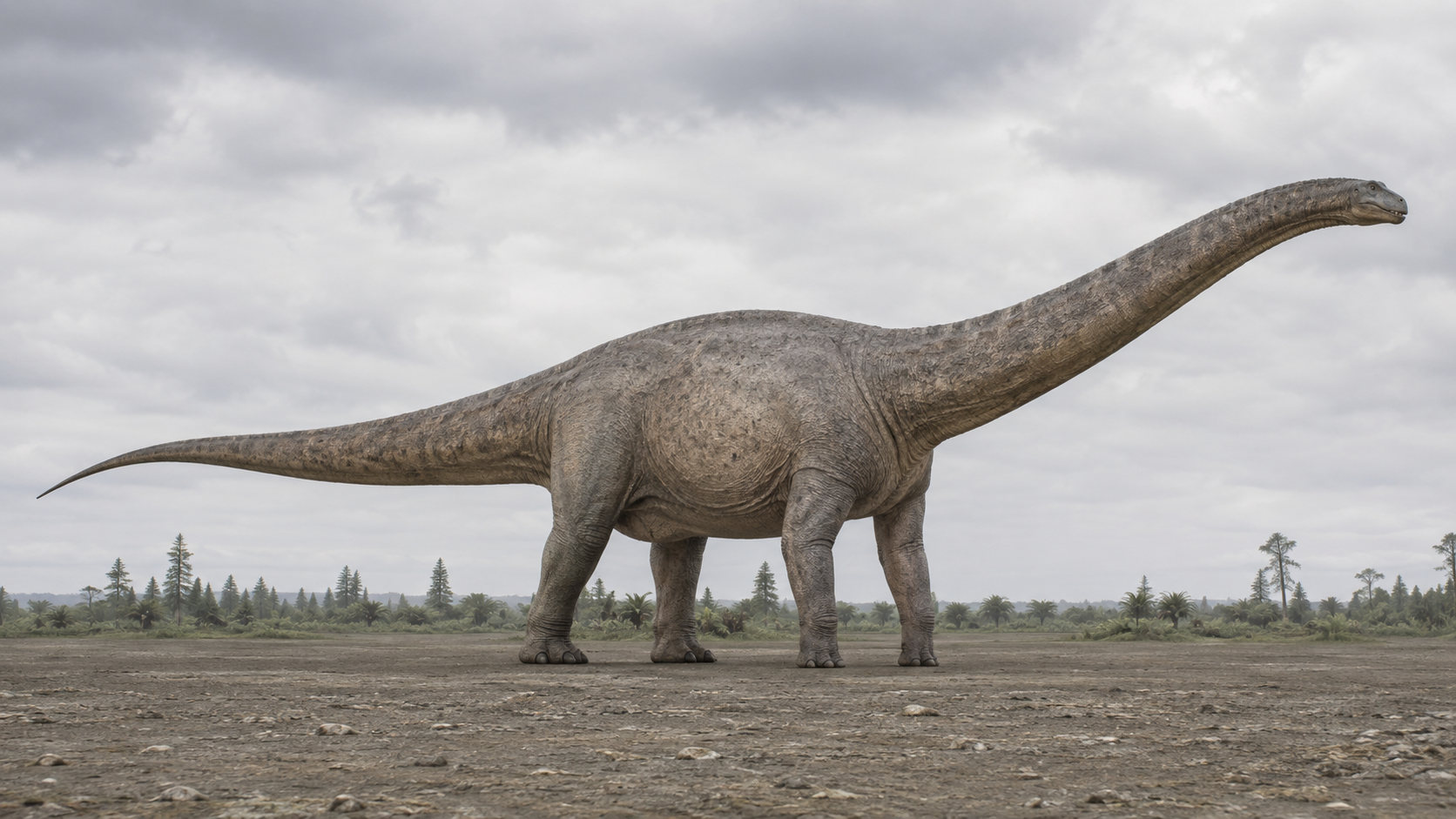
Reconstruction prompt · Used to generate the first image.
02Creature

Dreadnoughtus schrani reconstruction.
Reconstruction · ImageGen, informed by fossil anatomy.

03Tracked video

Tracked video · SAM 3 isolates the animal; optical flow tracks its body and feet.

04Mesh + texture

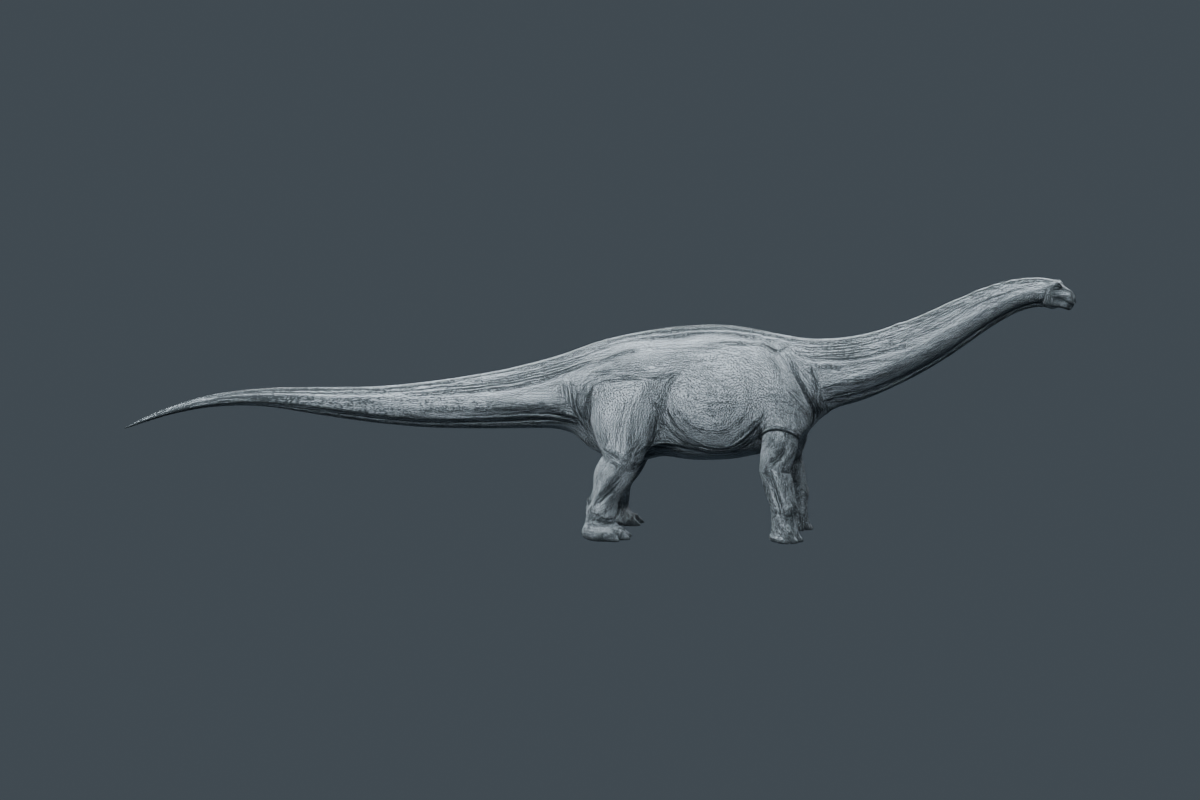
Dreadnoughtus schrani mesh with its triangle edges visible.
Triangulated mesh · Hunyuan 3D from the reconstruction; rendered in Blender.
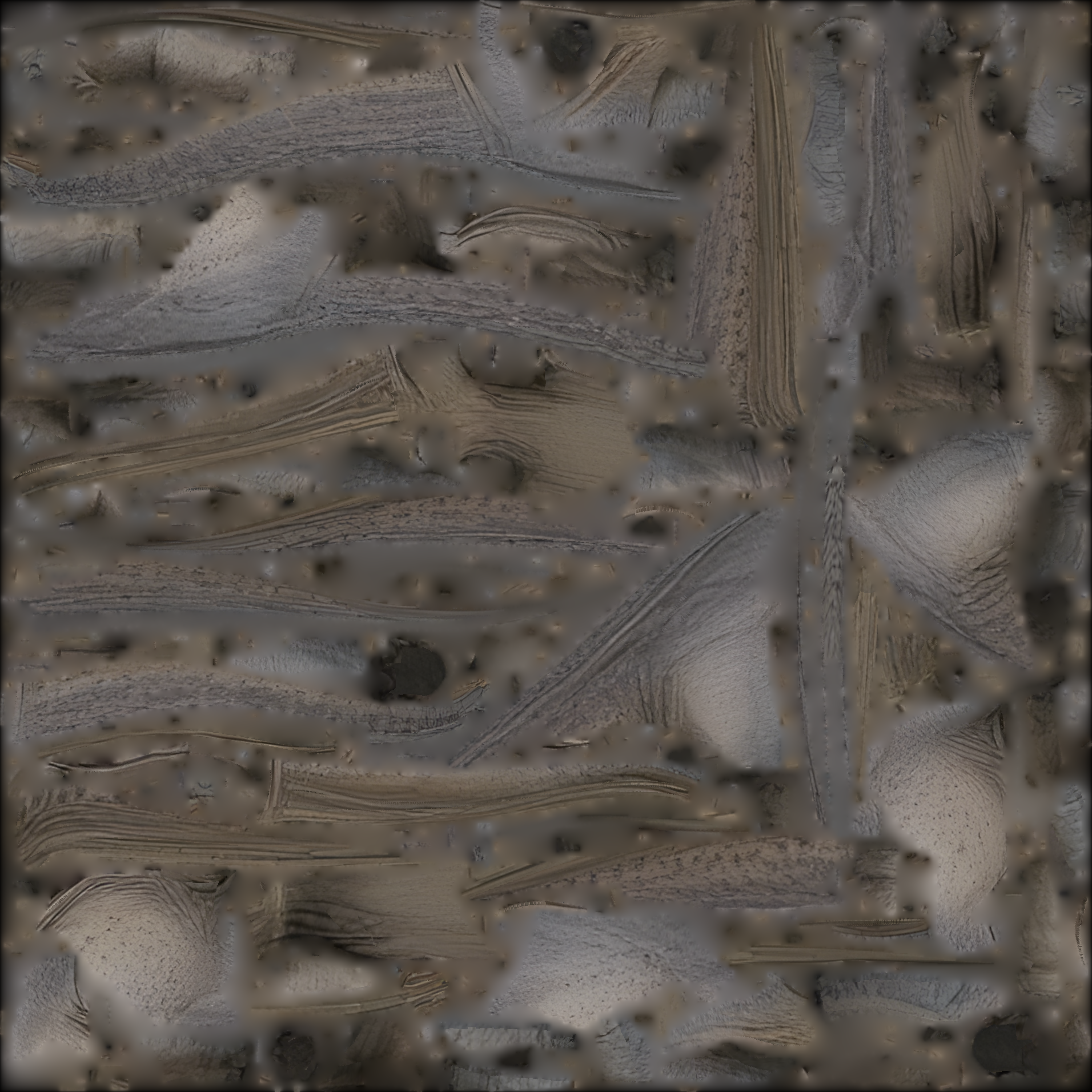
Base-color texture atlas extracted from the Dreadnoughtus schrani model.
Texture map · Extracted from the generated model.

05WebGL render

Animated model · Tracked gait + simulated neck, tail and belly inertia.

Reference ↑
LOADING 3D
DREADNOUGHTUS SCHRANI
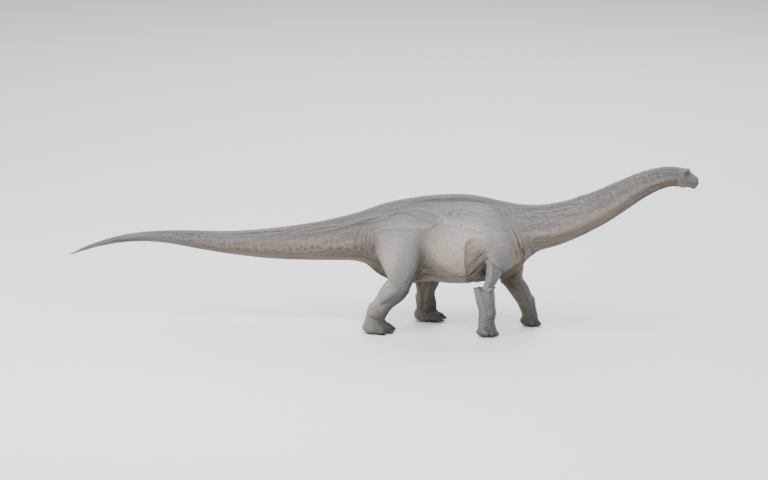
Preview of the reconstructed Dreadnoughtus schrani model.

3D preview · Rendered from the generated mesh.

Loading the animated model…

Drag to orbit · Scroll to zoom
0.0 / 8.0 s

A gait reconstruction. Far-side limbs, depth and tissue properties are inferred.

Shared technique

ImageGen creates the reference; Kling supplies motion; Hunyuan 3D builds the complete mesh. Tracking guides the skeleton and any cuts needed for articulation. Joints and ground contact constrain the movement; Three.js renders the result.

New studies use natural scenes and markerless tracking, with SAM 3 separating subject from background. The earlier Lystrosaurus suit and Tiktaalik green screen remain as experiments.

This is a reconstruction workflow. Generated video, inferred geometry and assumed material properties cannot establish biological accuracy or physically optimal motion.

Rigging choices
Lystrosaurus · Continuous skin
The skin is continuous across the torso, limbs, neck and tail. Separate rigid body pieces would produce seams and prevent natural skin and belly deformation.
Tiktaalik · Continuous skin
The fish-like trunk, tail and fin membranes form a continuous deformable surface. Fin rays and body bends need their own controls without breaking the skin into rigid pieces.
Dreadnoughtus · Continuous skin
Continuous skin connects the long neck, trunk, tail and limbs. Many vertebral and tissue controls should deform one body surface without mechanical seams.
Basilisk drone · Rigid pieces cut from the mesh
Start with the complete mesh. Cut armor, leg links, pads and equipment at structural joints where they need to move independently, keeping each piece rigid and its attachment intact.
Hunter-killer drone · Skin + rigid attachments
Generate the entire four-arm cyborg as one mesh. Keep the living torso continuous; cut the four armored insect-like arms, pincer segments, rotor outriggers, ducts and gun housings at their mechanical joints during rigging.
Cheetah · Continuous skin
A continuous spotted surface bends at joints, with structural supports for the rib cage, pelvis, skull and limb cores.

Generate the whole mesh first. Keep skin continuous; cut rigid pieces where joints require separate movement. Mesh pieces never limit skeleton detail.

Catches + fixes

Hidden motion and missing depth
Overlapping limbs can confuse tracking, and one view cannot reveal depth. Uncertain observations are filtered out; hidden limbs are reconstructed from the visible motion. Those inferred poses remain distinct from observed tracks.
Different bodies need different constraints
Each rig preserves segment lengths and adapts support to its body. The Basilisk drone gives every supported motion group its own control and keeps its metal parts rigid. Repeatable motion adds controls. Basilisk’s paired limbs share dimensions and attachments; body controls follow its long axis. Offsets from that axis require an explicit reason tied to the reference.
Snapping joints and uneven steps
Dreadnoughtus’s knees and elbows flipped bend direction during a stride. Stable bend directions, slight rear-knee flexion, smooth foot lift and landing, and a continuous final partial step corrected those jumps.
Secondary motion needs separate treatment
Damped inertia adds lag to bellies, tails, long necks, fin rays and mounted equipment. It responds to the fitted movement while preserving the primary gait; the physics toggle reveals the added motion.