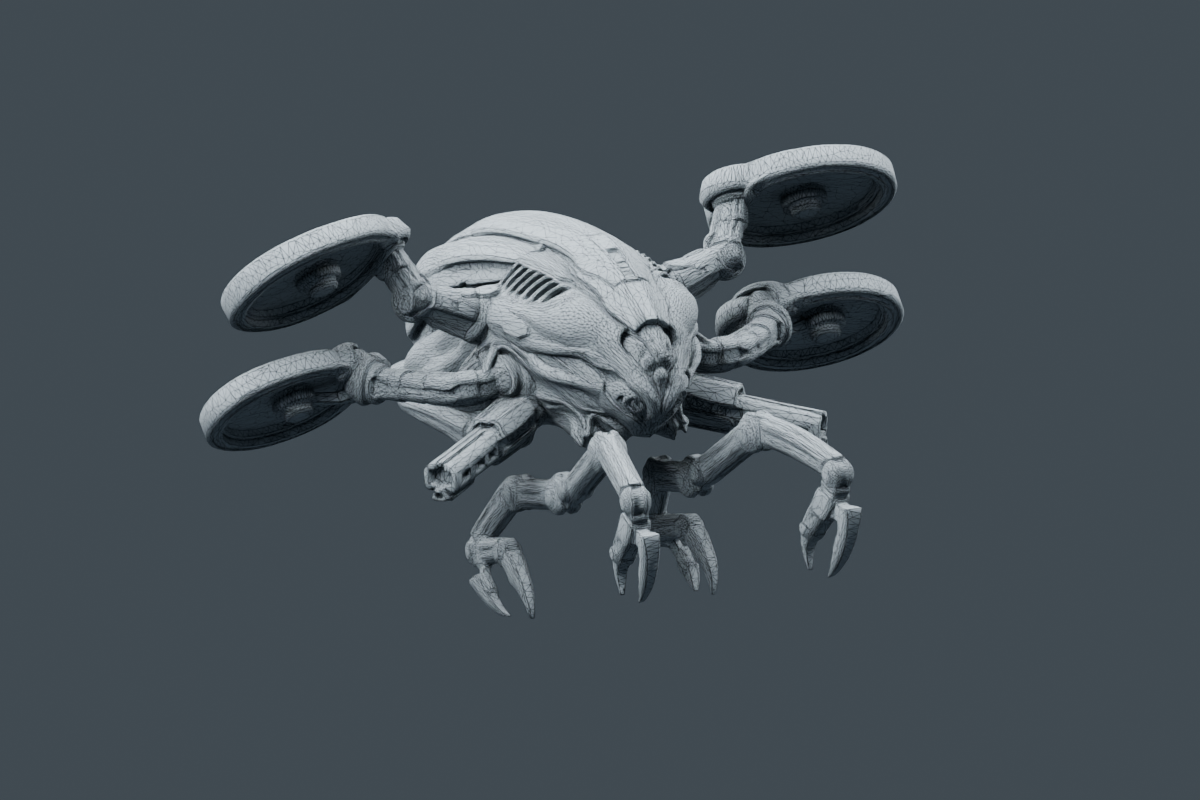
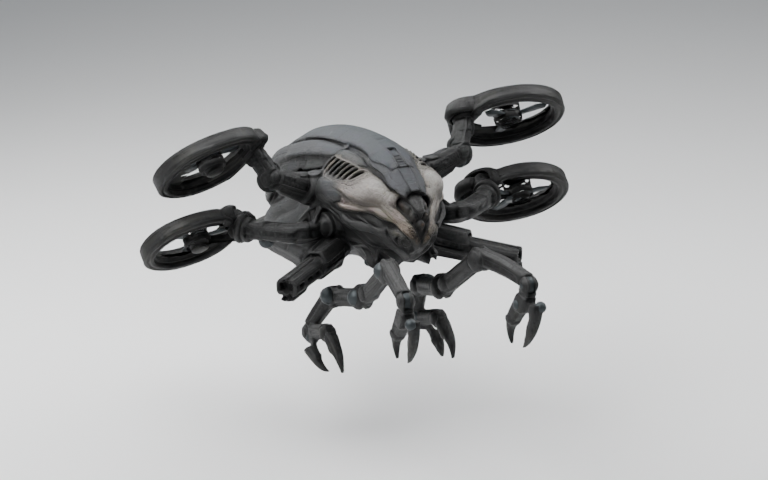
Hunter-killer drone in motion.

01Prompt

A biomechanical hunter-killer with four fully armored cybernetic insect-like arms, four articulated ducted rotors and two low-slung guns. Pale living tissue remains inside the armored thorax.
Full prompt
Use case: precise-object-edit.
Asset type: revised concept image for the existing Hunter-killer drone motion study.
Input image: edit target. Preserve this drone's identity, pale living torso, charcoal armored thorax, amber sensors, exactly FOUR articulated ducted rotors, TWO low-slung gun housings, industrial setting, cinematic light, material detail, and front three-quarter camera.

Change the grasping arms only. Completely replace the TWO current sinewy organic arms with exactly FOUR ARMORED CYBERNETIC BUG-LIKE ARMS. Arrange them as two matched bilateral pairs attached at four separate, legible hardpoints on the underside of the thorax. These four arms are additional to, and clearly separate from, the four rotor outriggers. Every arm must be visibly traceable from its own body attachment through its elbow to its terminal claw.

Make the new arms unmistakably insect-like and mechanical: folded mantis-like joint geometry, three rigid tapered segments, layered dark charcoal exoskeletal armor, compact articulated hinge housings, sealed mechanical joints, subtle cables contained within armor, and small angular two-finger grasping pincers. All four arms are armored throughout. No exposed fleshy ropes, muscular forearms, long skin bridges, dangling tendons, human hands, or organic claw stalks. Keep the living tissue on the torso.

Pose all FOUR arms so they can be counted immediately: the forward pair hangs lower and reaches slightly forward; the second pair fans outward behind them, with its elbows and pincers visible in separate silhouette gaps. Keep comparable lengths and matched left/right construction, with modest independent pose differences. Separate the limbs from the guns and from each other. This is still a hovering drone, not a walking insect. Leave generous clear space around every rotor, arm and pincer; slightly widen the framing only if needed to contain them all.

Maintain the original grimy, photoreal biomechanical science-fiction style, weathered matte gunmetal, pale organic core and restrained amber optics. One complete drone in one image. No people, targets, combat, firing, blood, gore, explosions, diagrams, labels, text, logo, watermark, extra rotors or extra arms.

Concept art prompt · Used to generate the first image.
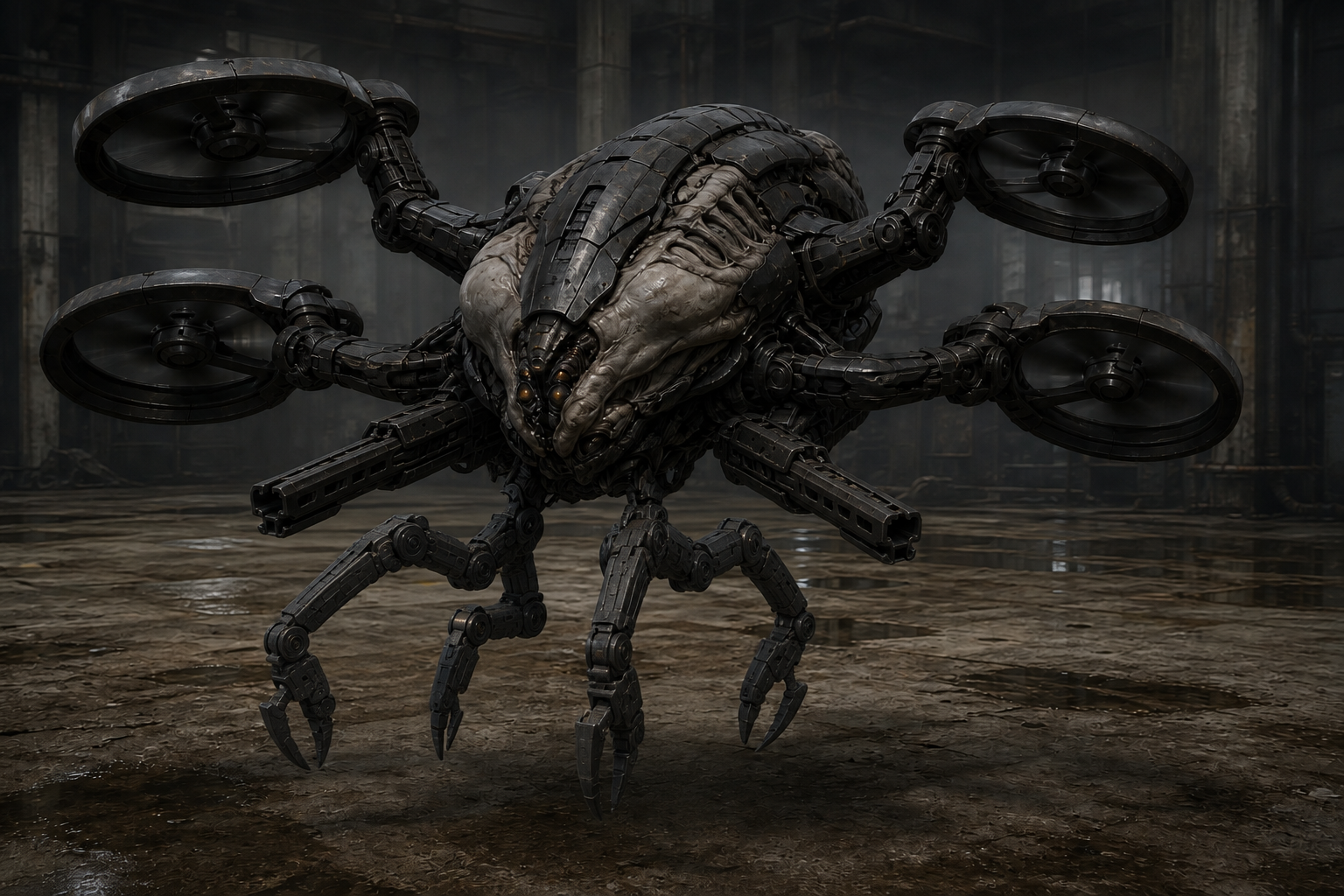
02Creature

Hunter-killer drone concept art.
Concept art · ImageGen; original biomechanical drone design.

03Tracked video

Tracked video · TAPNext++ 512 + SAM 3. Colors show motion groups; white lines show fitted image axes.

04Mesh + texture

Hunter-killer drone mesh with its triangle edges visible.
Triangulated mesh · Hunyuan 3D from the reconstruction; rendered in Blender.
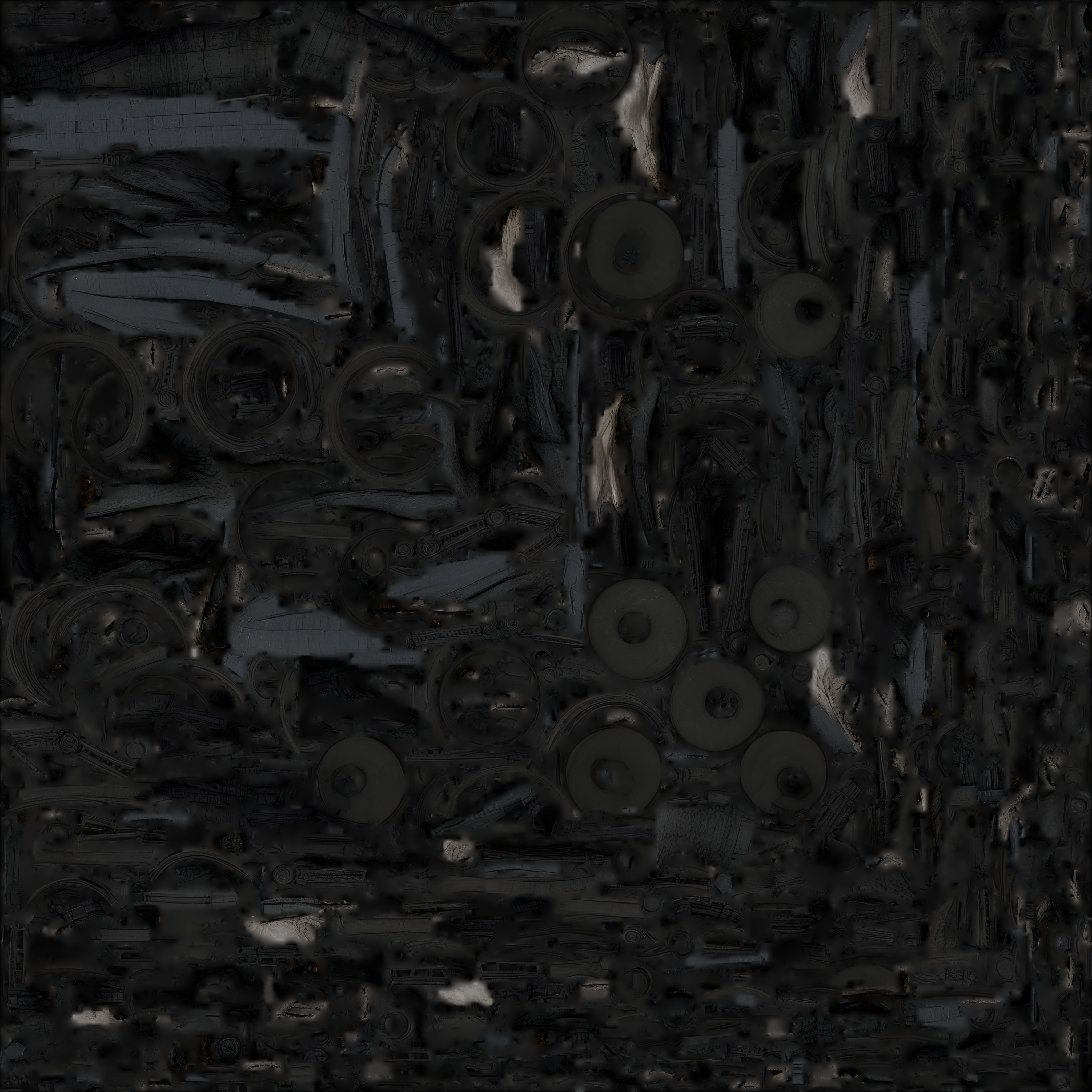
Base-color texture atlas extracted from the Hunter-killer drone model.
Texture map · Extracted from the generated model.

05WebGL render

Animated model · Video-fitted rig + simulated tissue inertia. Fan rotation is inferred.

Reference ↑
LOADING 3D
HUNTER-KILLER DRONE
Preview of the reconstructed Hunter-killer drone model.

3D preview · Rendered from the generated mesh.

Loading the animated model…

Drag to orbit · Scroll to zoom
0.0 / 8.0 s

Fictional hover study. Hidden depth, fan speed and tissue properties are inferred.

Shared technique

ImageGen creates the reference; Kling supplies motion; Hunyuan 3D builds the complete mesh. Tracking guides the skeleton and any cuts needed for articulation. Joints and ground contact constrain the movement; Three.js renders the result.

New studies use natural scenes and markerless tracking, with SAM 3 separating subject from background. The earlier Lystrosaurus suit and Tiktaalik green screen remain as experiments.

This is a reconstruction workflow. Generated video, inferred geometry and assumed material properties cannot establish biological accuracy or physically optimal motion.

Rigging choices
Lystrosaurus · Continuous skin
The skin is continuous across the torso, limbs, neck and tail. Separate rigid body pieces would produce seams and prevent natural skin and belly deformation.
Tiktaalik · Continuous skin
The fish-like trunk, tail and fin membranes form a continuous deformable surface. Fin rays and body bends need their own controls without breaking the skin into rigid pieces.
Dreadnoughtus · Continuous skin
Continuous skin connects the long neck, trunk, tail and limbs. Many vertebral and tissue controls should deform one body surface without mechanical seams.
Basilisk drone · Rigid pieces cut from the mesh
Start with the complete mesh. Cut armor, leg links, pads and equipment at structural joints where they need to move independently, keeping each piece rigid and its attachment intact.
Hunter-killer drone · Skin + rigid attachments
Generate the entire four-arm cyborg as one mesh. Keep the living torso continuous; cut the four armored insect-like arms, pincer segments, rotor outriggers, ducts and gun housings at their mechanical joints during rigging.
Cheetah · Continuous skin
A continuous spotted surface bends at joints, with structural supports for the rib cage, pelvis, skull and limb cores.

Generate the whole mesh first. Keep skin continuous; cut rigid pieces where joints require separate movement. Mesh pieces never limit skeleton detail.

Catches + fixes

Hidden motion and missing depth
Overlapping limbs can confuse tracking, and one view cannot reveal depth. Uncertain observations are filtered out; hidden limbs are reconstructed from the visible motion. Those inferred poses remain distinct from observed tracks.
Different bodies need different constraints
Each rig preserves segment lengths and adapts support to its body. The Basilisk drone gives every supported motion group its own control and keeps its metal parts rigid. Repeatable motion adds controls. Basilisk’s paired limbs share dimensions and attachments; body controls follow its long axis. Offsets from that axis require an explicit reason tied to the reference.
Snapping joints and uneven steps
Dreadnoughtus’s knees and elbows flipped bend direction during a stride. Stable bend directions, slight rear-knee flexion, smooth foot lift and landing, and a continuous final partial step corrected those jumps.
Secondary motion needs separate treatment
Damped inertia adds lag to bellies, tails, long necks, fin rays and mounted equipment. It responds to the fitted movement while preserving the primary gait; the physics toggle reveals the added motion.