Tiktaalik in motion.

01Prompt

Tiktaalik roseae. A broad, flat head, low fish body, four lobed fins and a long tail. Slow, fin-assisted movement on a shallow-water substrate.
Full prompt
Use case: scientific-educational
Asset type: single realistic reconstruction image for a creature-animation website and image-to-3D reference.
Primary request: Generate exactly ONE scientifically informed, lifelike full-body reconstruction of Tiktaalik roseae. This is an artistic paleontological reconstruction grounded in the animal's fish anatomy, not a modern crocodile or salamander.
Scene/backdrop: clean neutral light-gray seamless studio background and floor, only a minimal soft contact shadow, no scenery or props.
Subject and anatomy: a long low fish-shaped animal with a broad dorsoventrally flattened triangular skull and rounded wide snout, eyes placed dorsally, and a short distinct mobile neck region. Four distinct paired lobed fins: the two pectoral fins immediately behind the head and two robust pelvic fins near the posterior trunk. Pectoral and pelvic appendages substantial and comparable in scale. Each fin has a short muscular base, shallow flexion, and a clearly ray-supported paddle or fan margin. They are fins with visible natural fin rays, not feet: no digits, fingers, toes, or claws. Belly stays very low above the ground, gently supported/propped on the shallowly flexed paired fins; absolutely no tall quadrupedal stance. Long tapering fish tail ending in a conservative, understated caudal fin. No large dorsal sail.
Composition/framing: horizontal 16:9, approximately 1672 by 941 pixels. Entire animal uncropped from tail tip to snout with generous margins, spanning approximately 75 percent of the width. Head faces RIGHT, tail LEFT. Camera in a slightly elevated near-side view, about 12 degrees above and 10 degrees off an exact profile, preserving a strong side silhouette while showing body depth, the broad flat head, and readable far-side fins. Arrange the naturally posed four fins so all four appendages can be distinguished.
Style/medium: photorealistic natural-history museum reconstruction with believable wetland-fish skin, very crisp fine scale texture and natural irregular brown/tan mottling that can later support markerless visual tracking. Restrained earthy tan, brown, and muted olive coloration, lighter underside. Soft neutral studio light, accurate material detail, calm still pose.
Constraints: naked natural animal only. NO mocap suit, NO clothes, NO garment, NO artificial dots, NO tracking patches, NO labels, NO markers, NO text, NO watermark. No ornaments or equipment.
Avoid: crocodile legs, mammal legs, fingers, toes, claws, salamander body, frog posture, raised terrestrial quadrupedal body, thick lizard tail, armor plates, giant dorsal sail, fantasy spikes, exaggerated head, cartoon styling.
Scientific scope: preserve the distinctive fish-to-tetrapod transitional proportions and substrate-propping fin anatomy; exact tail shape, color and soft tissues are conservative artistic reconstruction and should not be presented as anatomical certainty.

Reconstruction prompt · Used to generate the first image.
02Creature

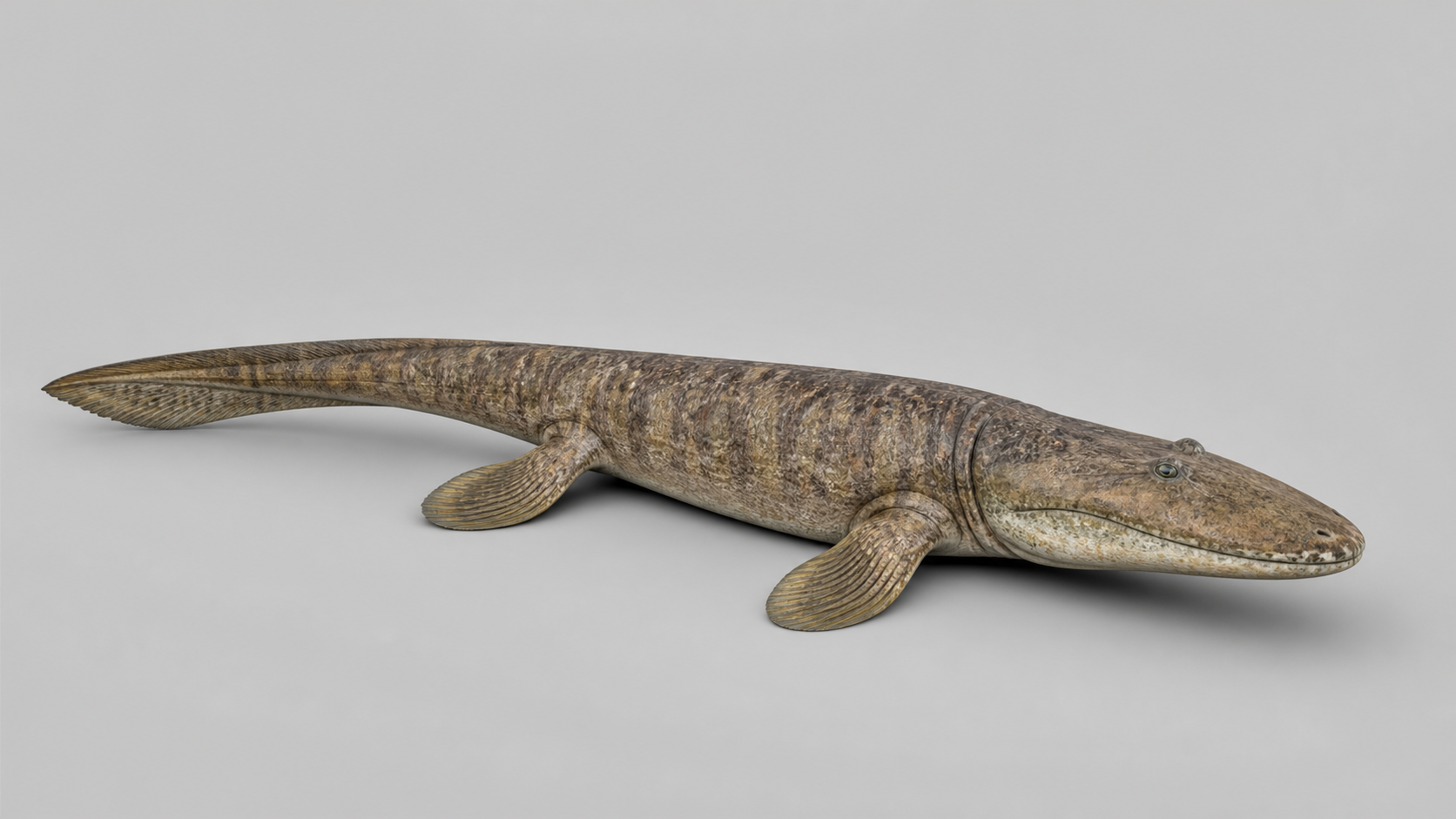
Tiktaalik roseae reconstruction.
Reconstruction · ImageGen, informed by fossil anatomy.

03Tracked video

Tracked video · Markerless 2D optical flow on the Kling video; uncertain observations omitted.

04Mesh + texture

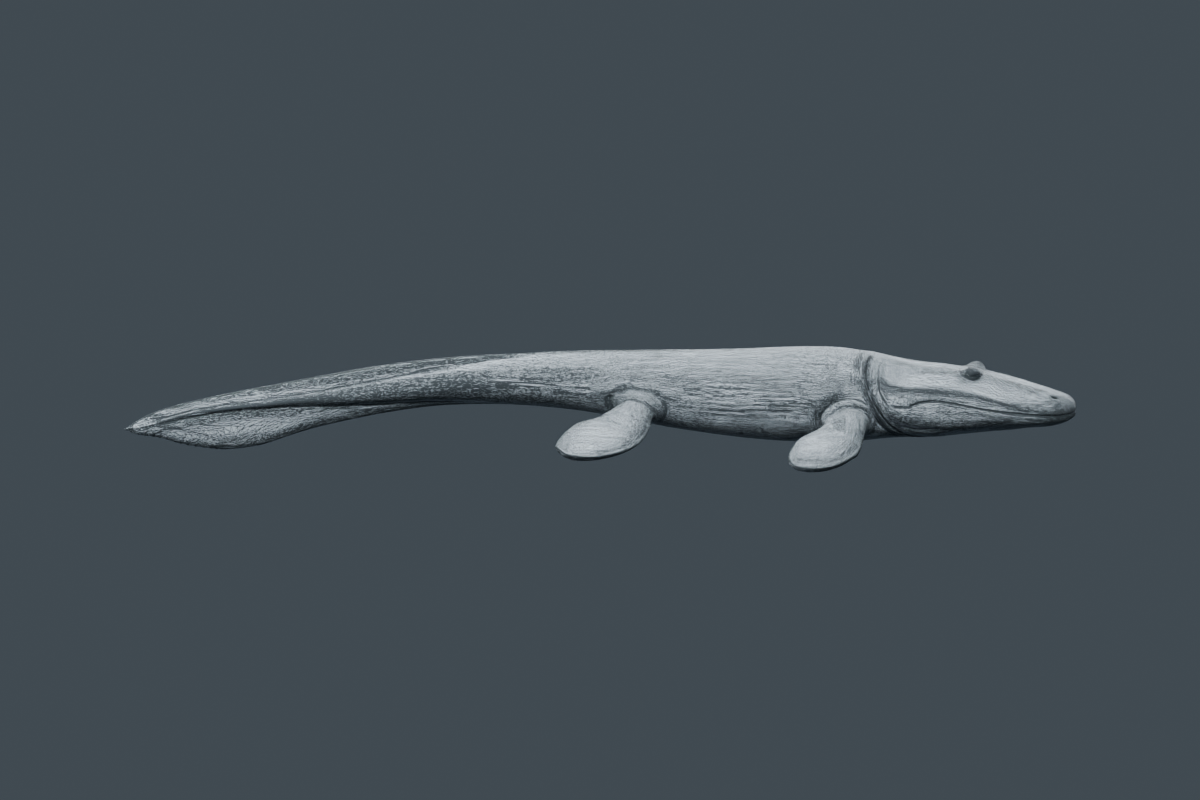
Tiktaalik roseae mesh with its triangle edges visible.
Triangulated mesh · Hunyuan 3D from the reconstruction; rendered in Blender.
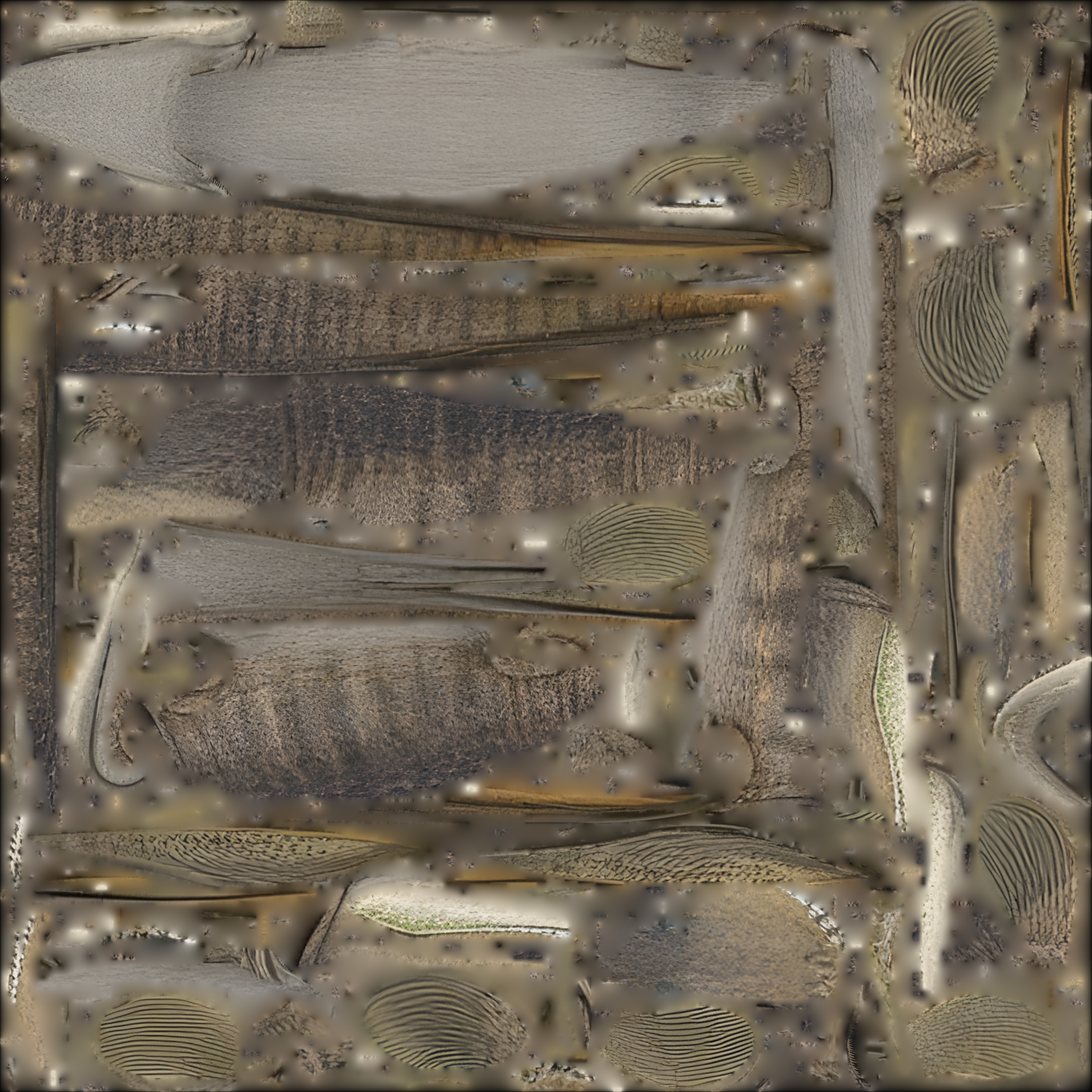
Base-color texture atlas extracted from the Tiktaalik roseae model.
Texture map · Extracted from the generated model.

05WebGL render

Animated model · Video-fitted motion + simulated fin, tail and belly inertia.

Reference ↑
LOADING 3D
TIKTAALIK ROSEAE
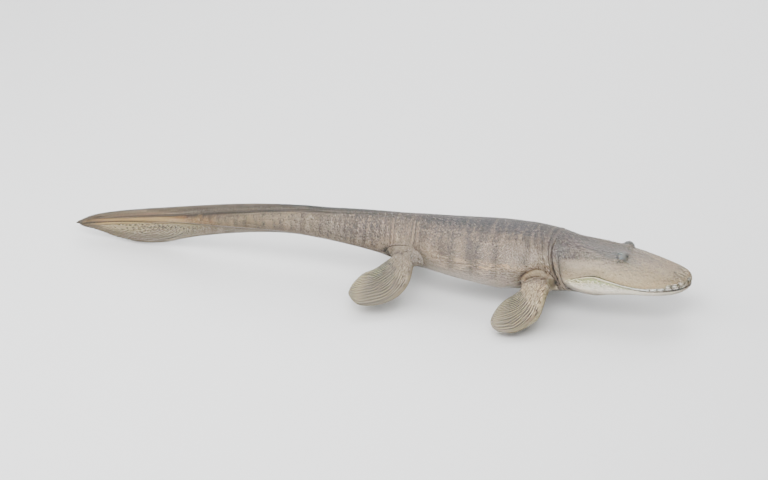
Preview of the reconstructed Tiktaalik roseae model.

3D preview · Rendered from the generated mesh.

Loading the animated model…

Drag to orbit · Scroll to zoom
0.0 / 8.0 s

Reconstructed shallow-water motion. Hidden fins, depth and material properties are inferred.

Shared technique

ImageGen creates the reference; Kling supplies motion; Hunyuan 3D builds the complete mesh. Tracking guides the skeleton and any cuts needed for articulation. Joints and ground contact constrain the movement; Three.js renders the result.

New studies use natural scenes and markerless tracking, with SAM 3 separating subject from background. The earlier Lystrosaurus suit and Tiktaalik green screen remain as experiments.

This is a reconstruction workflow. Generated video, inferred geometry and assumed material properties cannot establish biological accuracy or physically optimal motion.

Rigging choices
Lystrosaurus · Continuous skin
The skin is continuous across the torso, limbs, neck and tail. Separate rigid body pieces would produce seams and prevent natural skin and belly deformation.
Tiktaalik · Continuous skin
The fish-like trunk, tail and fin membranes form a continuous deformable surface. Fin rays and body bends need their own controls without breaking the skin into rigid pieces.
Dreadnoughtus · Continuous skin
Continuous skin connects the long neck, trunk, tail and limbs. Many vertebral and tissue controls should deform one body surface without mechanical seams.
Basilisk drone · Rigid pieces cut from the mesh
Start with the complete mesh. Cut armor, leg links, pads and equipment at structural joints where they need to move independently, keeping each piece rigid and its attachment intact.
Hunter-killer drone · Skin + rigid attachments
Generate the entire four-arm cyborg as one mesh. Keep the living torso continuous; cut the four armored insect-like arms, pincer segments, rotor outriggers, ducts and gun housings at their mechanical joints during rigging.
Cheetah · Continuous skin
A continuous spotted surface bends at joints, with structural supports for the rib cage, pelvis, skull and limb cores.

Generate the whole mesh first. Keep skin continuous; cut rigid pieces where joints require separate movement. Mesh pieces never limit skeleton detail.

Catches + fixes

Hidden motion and missing depth
Overlapping limbs can confuse tracking, and one view cannot reveal depth. Uncertain observations are filtered out; hidden limbs are reconstructed from the visible motion. Those inferred poses remain distinct from observed tracks.
Different bodies need different constraints
Each rig preserves segment lengths and adapts support to its body. The Basilisk drone gives every supported motion group its own control and keeps its metal parts rigid. Repeatable motion adds controls. Basilisk’s paired limbs share dimensions and attachments; body controls follow its long axis. Offsets from that axis require an explicit reason tied to the reference.
Snapping joints and uneven steps
Dreadnoughtus’s knees and elbows flipped bend direction during a stride. Stable bend directions, slight rear-knee flexion, smooth foot lift and landing, and a continuous final partial step corrected those jumps.
Secondary motion needs separate treatment
Damped inertia adds lag to bellies, tails, long necks, fin rays and mounted equipment. It responds to the fitted movement while preserving the primary gait; the physics toggle reveals the added motion.